Table of contents
- Acknowledgements
- Introduction
- Project objectives
- Leadgate Primary School
- Why is writing so challenging for children?
- Why was Clicker chosen for the project?
- Outline of the project
- The pre and post assessment task
- Outcomes of the assessment task
- Other outcomes of the project
- Conclusion
- Next steps
- Bibliography
- Appendix 1: Writing Task Assessment Grid
- Appendix 2: Progress Child A - Child I
- Contact information

Acknowledgements
The Boosting Writing Skills with Clicker project was made possible through the support, collaboration and enthusiasm of a small number of dedicated individuals.
My sincere thanks go to Helen Handy, Class Teacher and Deputy SEND Coordinator for Key Stage 2 at Leadgate Primary School, whose expertise, commitment to inclusion and thoughtful use of Clicker were central to the success of the project. Her reflective practice and deep understanding of her pupils’ needs ensured the intervention was meaningful, responsive and firmly embedded in daily classroom routines.
I am very grateful to the pupils from Leadgate Primary School’s NEST Enhanced Learning Provision, whose openness, engagement and determination brought this project to life. Their voices and experiences added authenticity and richness to the findings of this project.
I would also like to thank my colleague, Alix Kirtley, Advisory Inclusion Teacher for Specific Learning Difficulties, Motor Difficulties and Assistive Technology, for her valued contribution to the development of the assessment grid used to moderate the children’s writing tasks (Appendix 1). Her professional insight and support in moderating the children’s work was instrumental in ensuring consistency, rigour and fairness within the assessment process.
Thanks are also extended to Crick Software, and particularly Katy Preston, Customer Experience Consultant, for her professional support and contribution to data analysis, which helped strengthen the robustness of the evaluation.
Finally, I would like to acknowledge the continued support of the SEND & Inclusion Service at Durham County Council, whose ongoing commitment to assistive technology continues to support improved outcomes, independence and inclusion for children and young people with SEND.
Julie Brown
Advisory Inclusion Teacher for Assistive Technology
Introduction
The Writing Framework was published by the Department for Education (DfE) in July 2025 to address long-standing concerns about writing standards in primary schools in England. The DfE report writing outcomes had not recovered since the Covid pandemic, with disadvantaged and pupils with Special Educational Needs and Disabilities (SEND) particularly affected - only 30% of SEND pupils met expected Key Stage 2 standards in writing in 2024.
In response to this, Durham County Council’s SEND & Inclusion Service wanted to explore ways to improve writing outcomes for children and young people with SEND who attend an Enhanced Learning Provision (ELP) within County Durham. Working in partnership with Crick Software and Leadgate Primary School, a small-scaled project called ‘Boosting Writing Skills with Clicker’ was implemented to investigate the effectiveness of using Clicker software to support the acquisition of writing skills for children educated in an ELP setting. The project was led by Julie Brown, Advisory Inclusion Teacher for Assistive Technology (AT), from the Cognition & Learning Team within the SEND & Inclusion Service.
Project objectives
- To assess the effectiveness of Clicker support writing software in enhancing the writing skills of children and young people educated in an Enhanced Learning Provision (ELP).
- To compare students' writing performance before and after the use of Clicker software.
- To evaluate the effectiveness of using Clicker to aid independence and empower students to become independent learners.
Leadgate Primary School
Leadgate Primary School is one of eight primary schools in County Durham with an Enhanced Learning Provision (ELP) called NEST (Nurturing, Education, Succeeding Together). NEST is designed to support Key Stage 2 pupils who have identified needs in social communication and interaction, as well as cognition and learning. By offering a highly structured, nurturing environment, pupils can thrive academically, socially, and emotionally. NEST provides tailored teaching, life-skills development, and specialist
interventions for up to eight pupils, working closely with families and the local authority to ensure each child’s needs are met. NEST is managed by Helen Handy, class teacher and Deputy SEND Coordinator for Key Stage 2 (SENDCO KS2), who ensures each child develops confidence, independence and the skills needed to succeed in their learning and wider life.
Why is writing so challenging for children?
Writing is recognised as a complex task, placing unusually high demands on young learners because it requires them to think, organise, remember, and transcribe ideas all at the same time. The DfE’s Writing Framework (2025) describes writing as one of the hardest challenges pupils face at school because proficient writing requires coordination of many complex sub-skills, outlined below.
- Writing requires managing multiple processes at once
Writing is a high-cognitive-load task because children must manage many processes at once (ideas, vocabulary, spelling, handwriting, grammar, and structure). Skilled writing requires simultaneous control of:
- Spelling
- Handwriting
- Grammar
- Sentence construction
- Paragraphing
- Cohesion
- Purpose and audienc
- Writing overloads a child’s working memory
Writing is more demanding than speaking or reading because children must manage many processes at once (as identified above) and this places large demands on a child’s working memory. - Transcription skills (handwriting + spelling) are not yet automatic
Mastering transcription skills takes time and when handwriting and spelling are not fluent, children have difficulty focusing on ideas and/or structure of writing tasks. Many young children and children with SEND, have not automated the basics of forming letters and spelling words, and writing only becomes fluent once pupils achieve automaticity in transcription, freeing cognitive space for composition. Without this automaticity, children focus heavily on how to write instead of what to write. - Writing requires sophisticated language skills
To write effectively, children must understand:
- Sentence structure
- Grammar
- Vocabulary
- How written language differs from spoken language
Writing requires more complex vocabulary, grammar and sentence control than everyday speech, so children need time to develop these skills. Moving from spoken to written language is a major developmental leap.
- Generating ideas is harder than we assume
While reading involves recognising meaning, writing involves generating meaning. Children must produce rather than receive language, making writing slower, more effortful, and more cognitively complex. Many children report difficulty with:
- Deciding what to write
- Finding ideas
- Knowing how to structure them
National Literacy Trust research (2025) reveals 1 in 3 children struggle with generating ideas, and many find planning and structuring writing challenging. Even confident writers can become stuck when they face a blank page. Many children struggle to think of what to write, plan it, or structure it, which can lead to frustration or avoidance.
- Motivation, confidence, and fear of ‘getting it wrong’ play a role
Many children feel pressure around correctness, which can limit creativity and engagement. Research shows that anxieties about not knowing what to write, making mistakes, or running out of ideas can significantly hinder progress. Fear of mistakes and uncertainty about what “good writing” looks like can reduce motivation and make writing feel harder.
Why was Clicker chosen for the project?
Clicker is an award winning, child-friendly word processing program with additional support tools designed to guide children through the processes of planning, writing, and reviewing their work, helping them become more confident and independent writers. Key features and benefits include:
- Planning Tools (Clicker Board)
- Helps children organise ideas using pictures, words and audio.
- Supports with the generation of ideas, creativity and content of writing.
- Writing Support (Clicker Grids, Sentence Sets, Word Banks)
- Provides vocabulary, sentence starters and structure.
- Helps children who find a blank page difficult or need scaffolding aids.
- Speech Feedback, Word Prediction & Spelling Help
- Clicker reads words and sentences aloud so pupils can check their own work.
- Word prediction suggests words to keep writing flowing and help pupils write more independently and without needing an adult as often.
- Voice Notes
- Children record ideas orally instead of trying to remember everything.
- Reduces cognitive load and supports working memory.
- Visual Support (Widgit Symbols & Crick Picturize)
- Adds helpful images to words and Clicker grids.
- Supports comprehension, word-finding and memory.
- Word processing
- Typing is easier and less tiring than handwriting.
- Typing can remove physical barriers such as poor fine-motor control, slow writing speed, fatigue, or untidy handwriting.
- Work is clearer and more readable, helping children feel more confident.
- Clicker Analytics
- Tracks how each child works and produces a final piece of writing.
- Helps teachers tailor support more effectively and inform planning.
- Ready-Made LearningGrids
- 1000s of high-quality, ready-made differentiated activities are available at the click of a button.
- Saves preparation time for teachers and support staff.
In summary, Clicker removes barriers to writing by offering structure, reducing cognitive load and giving pupils the tools they need to express their ideas independently.
Outline of the project
The project was a small-scaled project, involving one primary school with an ELP for the duration of one school term. Nine children participated in total (6 boys and 3 girls), aged between 7 and 11 years. This group included all eight pupils currently attending the ELP, alongside one additional mainstream pupil who was invited to take part as staff felt this student would benefit from the additional support provided by Clicker.
The children represented a range of neurodivergent profiles, with needs associated with autism, ADHD, speech, language and communication difficulties, sensory processing differences, and specific learning difficulties, including dyslexia. Most of the children experienced significant challenges with writing. For some, generating ideas was difficult; for others, the physical and cognitive demands of writing, such as keeping pace with their thoughts, forming letters, spelling, or organising sentences were the
main barriers. Several pupils also experienced difficulties with working memory, making it harder to retain ideas long enough to transfer them onto the page. Together, these challenges often led to frustration and a reluctance to engage in writing tasks, making this group particularly well suited to participate in the project.
To obtain impact data, school staff undertook a pre-assessment task with each child before the project commenced. They also completed an identical post-assessment task at the end of the project.
After the initial pre-assessment task was undertaken, Clicker was introduced to the children in a structured and considered way. Staff were trained in the use of Clicker to ensure they understood the software fully and could competently use it with the children. Software settings were changed to meet individual needs e.g. male/female voice, automatic capitalisation turned off, background colour changed, font size increased etc and a profile was created for each child. This meant Clicker was automatically set up to suit individual needs and preferences each time of use. Following this, Clicker was introduced gradually. At first, the basic functions were explored together—word prediction, text to speech feedback, and using templates in the form of Sentence Sets, Connect Sets and Word Banks. Then, Clicker was
integrated into regular literacy sessions. Helen Handy created personalised Clicker Sets linked to each child's targets and to the topics they were studying. The children not only used Clicker for independent writing in Literacy sessions, but also in guided group sessions, and for cross‑curricular tasks such as science explanations and history reports.
After nine weeks of Clicker use, the post-assessment task was completed with each child. Results are featured on p.10-14 and full details of each child’s progress is included in the appendices.
The pre and post assessment task
The pre and post assessment task consisted of six areas.
- Writing
- Concentration & focus
- Motivation for writing
- Typing
- Underlying ICT skills
- Confidence
Area 1 - Writing
For the pre assessment writing task the children were asked to write about their favourite holiday (handwritten), and in the post assessment task they were asked to write about their favourite school trip (using Clicker).
A rubric grid was used to score nine aspects of the children’s writing and an overall score achieved. A maximum of 5 marks were awarded for each aspect, with a best fit model used. A maximum of 45 marks could be awarded in total.
Scoring Guide – Best fit.
- Excellent (5 marks): Mastery.
- Good (4 marks): Solid understanding with minor issues.
- Satisfactory (3 marks): Fulfils brief or task.
- Basic (2 marks): Some understanding, but with notable gaps.
- Needs Improvement (1 point): Very limited understanding with significant gaps.
The nine aspects of writing assessed were: - Grammar
- Punctuation
- Spelling
- Vocabulary
- Sentence structure
- Coherence and organisation
- Content and creativity
- Presentation
- Length - Informed by DASH-2 (2024) Scaled Score Normative Data aged 8.00-8.11 years (free writing task).
See Appendix 1 for a copy of the assessment grid used.
Areas 2-6: Concentration & Focus, Motivation for Writing, Typing, Underlying ICT Skills and Confidence.
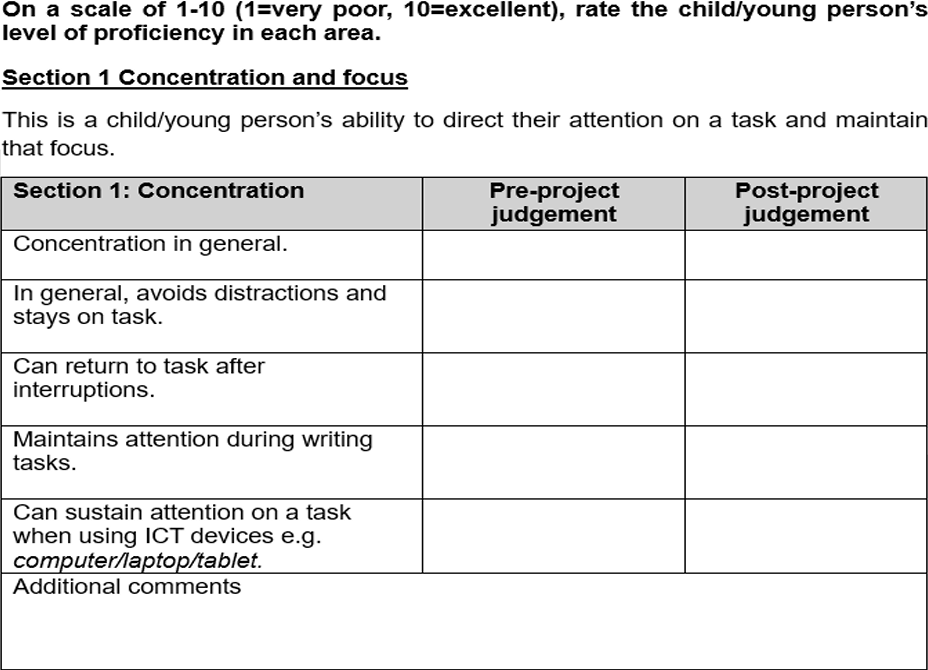
The other five areas of the assessment consisted of a series of rating questions using a Likert-type scale (where a level of judgement is given using a simple scale e.g.10 point scale). Rating questions were used as this offered a consistent, meaningful approach for staff completing the task, and thus would provide measurable, reliable data for the areas of concentration & focus, motivation for writing, typing, underlying
ICT skills and confidence.
Example of a rating question using a Likert-type scale:
Outcomes of the assessment task
Area 1: Writing
All children made progress in all areas assessed, and an in-depth analysis of each child’s progress in writing can be found in Appendix 2. For summative purposes, below is a bar chart illustrating the overall writing progress made by each child in the form of total scores, with a maximum of 45 marks awarded.

Below is a summary of the collective progress made by the children in the form of average scores. A maximum of 5 marks could be awarded for each area.
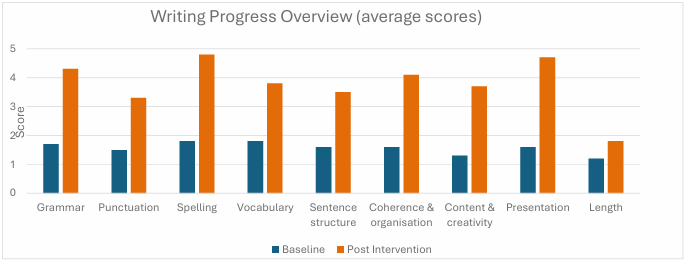
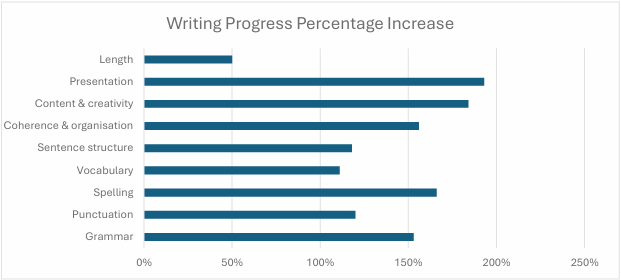
Progress was seen in all nine aspects of writing assessed, with significant progress in presentation, content and creativity, coherence and organisation, spelling and grammar.
Areas 2-6:
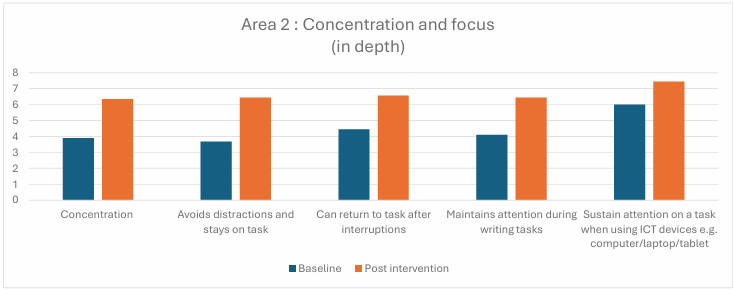
Progress was seen in all additional areas assessed and is summarised below. A maximum score of 10 could be awarded for each area.
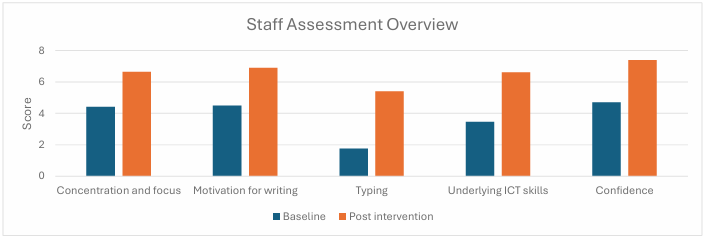
A more in-depth analysis for each area is shown below. A maximum score of 10 could be awarded per strand.
Concentration and Focus
Motivation for writing

Typing

Underlying ICT skills

Confidence

Other outcomes of the project
Staff views


Pupils’ views
To obtain children’s views, staff were asked to complete a questionnaire with each child which consisted of several statements with symbolised faces for pupils to indicate their response. Questions were categorised into four areas.
- Writing and Concentration
- Motivation and Effort
- Typing and Computer use
- Using Clicker
In addition, staff could record oral responses from each child in a comments box.
Example question:

Below is a summary of the children’s responses, before and after the project. A maximum of 4 could be scored in each strand.

Additional comments from pupils


Conclusion
Boosting Writing Skills with Clicker project set out to explore whether assistive technology could improve writing outcomes, independence and engagement for pupils with SEND educated within an Enhanced Learning Provision (ELP). Findings from this small-scale project demonstrate Clicker had a consistently positive impact across all areas assessed, with every child making measurable progress over the course of the intervention.
Most notably, significant improvements were seen in key aspects of writing, including presentation, content and creativity, coherence and organisation, spelling and grammar. These gains suggest that Clicker’s structured support and reduced transcription demands, enabled pupils to focus more effectively on the composition of their writing, rather than the mechanical processes that often act as a barrier.
Beyond writing outcomes, the project also highlighted substantial improvements in concentration, motivation, confidence, typing skills and underlying ICT competence. Staff observations and pupil voice data indicated that children were more willing to engage in writing tasks, sustained attention for longer periods and demonstrated greater pride and ownership in their work when using Clicker. Importantly, pupils were able to self-check and self-correct more independently, reducing reliance on adult support and contributing to increased confidence as learners.
Although the project involved a small cohort within a single setting, the strength and consistency of the outcomes provide compelling evidence for the effectiveness of Clicker as a reasonable adjustment for pupils with SEND who find writing challenging. The findings suggest that embedding Clicker within daily classroom practice has the potential to not only improve writing attainment but also support inclusion,
independence and learner wellbeing.
Furthermore, adopting Clicker at a whole-school level could strengthen ordinarily available provision for pupils with SEND by embedding appropriate writing support into everyday classroom practice. This aligns with the direction of national SEND reform, including the SEND and Alternative Provision White Paper and planned changes from 2026, which emphasise inclusive, high-quality provision and reduced reliance on reactive support.
Next steps
Building on the success of this project, Durham County Council’s SEND & Inclusion Service intends to undertake the following steps:
- Extend the scale of the project
Expand the use of Clicker across additional Enhanced Learning Provisions (ELPs) to explore its impact with larger cohorts and a wider range of SEND profiles. - Explore longer-term impact
Carry out a follow-up study with Leadgate Primary School to evaluate sustained progress in writing length, stamina, and attainment over time. - Provide continued staff training and support
Offer ongoing continued professional development (CPD) to ensure staff are confident in adapting Clicker resources to meet individual pupil needs and curriculum objectives. - Boost writing skills through the DocsPlus project
Implement a similar project within a secondary school with an In-school Alternative Provision to evaluate the effectiveness of DocsPlus (the sister software for secondary-aged pupils) in enhancing the writing skills of children and young people educated in such a setting. - Inform strategic planning
Use project findings to inform inclusion strategies across County Durham and further develop the Experts at Hand model, as outlined in the UK Government’s SEND White Paper 2026: Every Child Achieving and Thriving, to support improved writing outcomes for pupils with SEND.
Bibliography
Barnett, A.L., Henderson, S.E. & Scheib, B. (2024) DASH-2 Guidance: Detailed Assessment of Speed of Handwriting – Second Edition (STEC Guidance). Pearson. Available at: https://www.sasc.org.uk/media/j2uf115h/dash2-guidance
stec-september-2024.pdf
Department for Education (2025) The writing framework 2025. Available at: https://assets.publishing.service.gov.uk/media/68bec95444fd43581bda1c86/The_w
riting_framework_092025.pdf
Department for Education (2026) Every child achieving and thriving: reforming the schools and special educational needs and disabilities (SEND) system. Available at: https://www.gov.uk/government/publications/every-child-achieving
and-thriving
National Literacy Trust (2025) Children and young people’s writing in 2025. Available at: https://literacytrust.org.uk/research-services/research-reports/children
and-young-peoples-writing-in-2025/
National Literacy Trust (2025) Making sense of the DfE writing framework 2025: Takeaways from TeachBrief Live. Available at: https://literacytrust.org.uk/training
and-workshops/teachbrief/making-sense-of-the-dfe-writing-framework-2025
takeaways-from-teachbrief-live/
Appendix 1: Writing Task Assessment Grid

Appendix 2: Progress Child A - Child I


Contact information
Julie Brown
Advisory Inclusion Teacher for Assistive Technology
Cognition & Learning Team
SEND & Inclusion Service
Education Development Centre
Enterprise Way
Spennymoor
DL16 6YP
Telephone: 03000 263333
Website: www.durham.gov.uk/localoffer
Email: cognitionandlearning@durham.gov.uk
Crick Software Ltd
Crick House
Boarden Close
Moulton Park
Northampton
NN3 6LF
Telephone: +44 (0) 1604 671691
Website: www.cricksoft.com
Email: info@cricksoft.com