Thousands of UK schools are already using Clicker to deliver inclusive, classroom-based support that reduces barriers to reading and writing for every pupil.
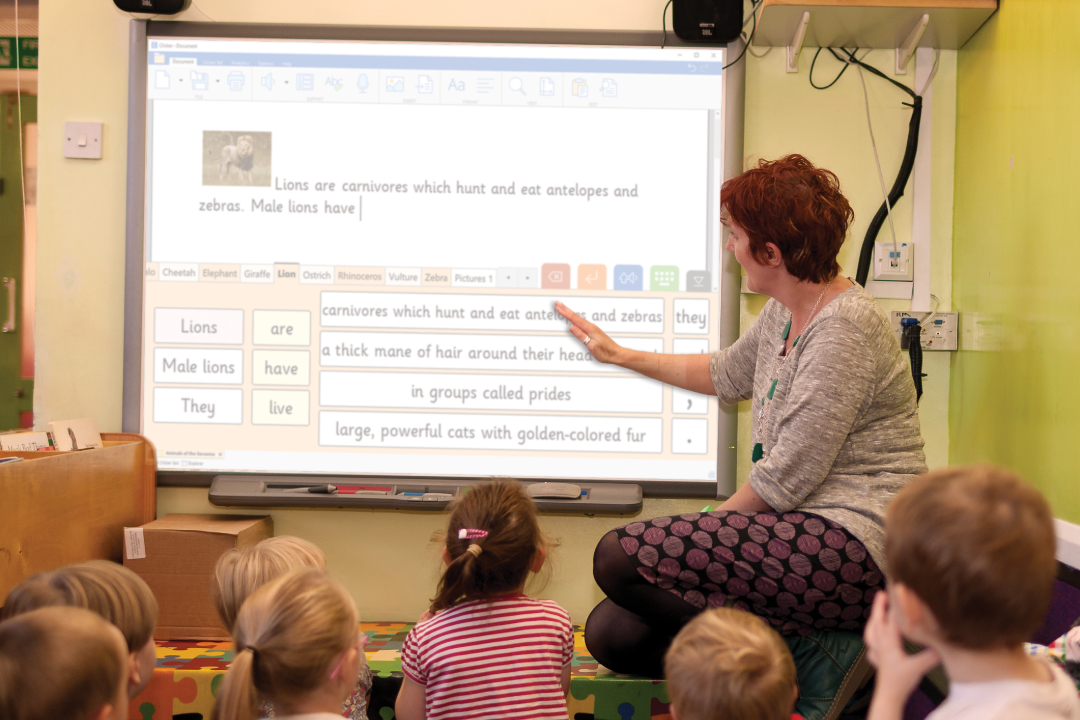
This takes the pressure off teachers and teaching assistants because it has the features that support children in the way we would.
The most noticeable benefit of Clicker is that it has given us so much more time within the classroom.”
St Catherine’s Academy
Why Clicker for Inclusive Mainstream Funding?
What sets Clicker apart from other assistive technology tools is its ability to work across all four layers of provision - from universal classroom use (writing frames, vocabulary grids, speech feedback), to targeted small‑group intervention (structured writing scaffolds and sentence‑building activities), to specialist SEND provision (personalised grids, symbol‑supported materials and alternative recording methods), through to enabling learners with more complex needs to access writing and achieve success alongside their peers.
This makes Clicker a cost-effective way to:


Which commonly occurring and predictable needs does Clicker address?
In every classroom, there will be children who:
- struggle to translate their thoughts into written output
- find it difficult to capture and organise their ideas
- need help with structuring sentences and spelling
- depend on adult support to get started or complete written tasks
- are unable to access curriculum content independently

Too often, writing support tools are introduced only when pupils begin to struggle, and only once a learner's needs reach a clear threshold - through formal identification, assessment, or diagnosis.
That means children spending weeks or months navigating lessons without the tools they need, not because they’ve been overlooked, but because the support isn’t designed to begin straight away.
By the time an intervention or ‘special’ tool is in place, the damage to their self-image is already done, and their relationship with literacy and learning is tainted.
When Clicker is part of universal provision from the start, learners don’t have to wait to begin experiencing success. The scaffolds that help them succeed can simply be switched on when needed, right there in the moment.
"Using the most supportive writing tool as our primary word processor made a big impact on our school. This way, everyone sees it as the normal way of working, not specifically for students who are struggling writers. Plus, the more experienced writer benefits from the support in the software too."
- Scott Salmond, Deputy Head of Craneswater School
Reducing provision disruption at key transition points
By embedding Clicker in Early Years and primary settings, and DocsPlus in secondary and post‑16, schools and trusts can provide a coherent literacy support pathway from Reception all the way to A‑levels. This consistency is particularly powerful at transition points, where pupils with SEND often experience the greatest disruption. A trust‑wide approach ensures that all learners - regardless of school or phase - benefit from familiar tools, predictable scaffolds, and a reliable platform for developing independence in writing.
Find out how we worked with Portsmouth to boost literacy attainment across 38 primary, secondary and special schools.

Evidence of Clicker's impact
Our research and school case studies demonstrate that Clicker has a significant positive impact on literacy outcomes, independence, and engagement for pupils with SEND.
- Increase in writing independence
Schools using Clicker consistently report that pupils who previously relied on adult scribes or produced very little written output are able to produce longer, more structured pieces of writing independently. Teachers note that Clicker’s scaffolds reduce cognitive load, enabling pupils to focus on content rather than mechanics. - Gains in confidence and engagement
Many schools highlight increased confidence among reluctant writers, particularly pupils with dyslexia, autism, or DLD. As pupils begin to experience success in writing, they become more willing to participate, engage more fully in lessons, and develop a more positive sense of themselves as learners and writers. - Measurable outcomes in SEND interventions
SENCos report that Clicker Analytics provides clear evidence of progress for pupils receiving targeted support. This has been particularly valuable for demonstrating impact during EHCP reviews and for monitoring the effectiveness of interventions. - Whole class benefits
Schools adopting Clicker as part of a universal design for learning approach report benefits for a wide range of learners, including their more confident writers, who are able to create more sophisticated and structured pieces of work.
Assistant Head and SENDCo,
Grove Road School
Year 1 Teacher and
Computing Lead
Clicker is a child-friendly literacy support platform that provides writing scaffolds, vocabulary support, text‑to‑speech, and accessible word processing tools. It directly supports the DfE’s expectation that schools remove predictable barriers to learning through high‑quality, ordinarily available provision.
What sets Clicker apart from other assistive technology tools is its ability to work across all four layers of provision - from universal classroom use (writing frames, vocabulary grids, speech feedback), to targeted small‑group intervention (structured writing scaffolds and sentence‑building activities), to specialist SEND provision (personalised grids, symbol‑supported materials and alternative recording methods), through to enabling learners with more complex needs to access writing and achieve success alongside their peers.
This makes Clicker a cost-effective way to:
- remove commonly occurring and predictable barriers for pupils with literacy, language, and working memory challenges.
- build staff capacity through easy‑to‑use templates, ready-made curriculum resources (these are completely customisable, so no need for multiple worksheets or making do with ‘not quite right’ paper activities!), and adaptive teaching tools.
- reduce reliance on 1:1 adult support by giving pupils the tools they need to access lesson tasks independently.
- support early intervention by providing immediate scaffolds for emerging literacy difficulties – you can adjust settings and support levels in seconds so that pupils can keep moving forwards.
- provide enhanced support for learners with more complex needs, using the same tool that their classmates are using.
In every classroom, there will be children who:
- struggle to translate their thoughts into written output
- find it difficult to capture and organise their ideas
- need help with structuring sentences and spelling
- depend on adult support to get started or complete written tasks
- are unable to access curriculum content independently
Too often, writing support tools are introduced only when pupils begin to struggle, and only once a learner's needs reach a clear threshold - through formal identification, assessment, or diagnosis.
That means children spending weeks or months navigating lessons without the tools they need, not because they’ve been overlooked, but because the support isn’t designed to begin straight away.
By the time an intervention or ‘special’ tool is in place, the damage to their self-image is already done, and their relationship with literacy and learning is tainted.
When Clicker is part of universal provision from the start, learners don’t have to wait to begin experiencing success. The scaffolds that help them succeed can simply be switched on when needed, right there in the moment.
"Using the most supportive writing tool as our primary word processor made a big impact on our school. This way, everyone sees it as the normal way of working, not specifically for students who are struggling writers. Plus, the more experienced writer benefits from the support in the software too."
- Scott Salmond, Deputy Head of Craneswater School
By embedding Clicker in Early Years and primary settings, and DocsPlus in secondary and post‑16, schools and trusts can provide a coherent literacy support pathway from Reception all the way to A‑levels. This consistency is particularly powerful at transition points, where pupils with SEND often experience the greatest disruption. A trust‑wide approach ensures that all learners - regardless of school or phase - benefit from familiar tools, predictable scaffolds, and a reliable platform for developing independence in writing.
(Find out how we worked with Portsmouth to boost literacy attainment across 38 primary, secondary and special schools here).
Our research and school case studies demonstrate that Clicker has a significant positive impact on literacy outcomes, independence, and engagement for pupils with SEND.
- Increase in writing independence
Schools using Clicker consistently report that pupils who previously relied on adult scribes or produced very little written output are able to produce longer, more structured pieces of writing independently. Teachers note that Clicker’s scaffolds reduce cognitive load, enabling pupils to focus on content rather than mechanics. - Gains in confidence and engagement
Many schools highlight increased confidence among reluctant writers, particularly pupils with dyslexia, autism, or DLD. As pupils begin to experience success in writing, they become more willing to participate, engage more fully in lessons, and develop a more positive sense of themselves as learners and writers. - Measurable outcomes in SEND interventions
SENCos report that Clicker Analytics provides clear evidence of progress for pupils receiving targeted support. This has been particularly valuable for demonstrating impact during EHCP reviews and for monitoring the effectiveness of interventions. - Whole class benefits
Schools adopting Clicker as part of a universal design for learning approach report benefits for a wide range of learners, including their more confident writers, who are able to create more sophisticated and structured pieces of work.
- Sasha Bune, Assistant Head and SENDCo, Grove Road School
- Sophie, Year 1 teacher and computing lead
If you’d like to explore how Clicker could support your school’s Inclusion Strategy and Inclusive Mainstream Funding plans this year, please book a discovery call with our team, email info@cricksoft.com or give us a call on 01604 671691.
Don’t miss our three-part blog series ‘Preparing you school’s Inclusion Strategy – Insights from school leaders, SENCos and digital specialists’:
Some top tips for preparing your Inclusion Strategy

See Clicker in action
If you’d like to explore how Clicker could support your school’s Inclusion Strategy and Inclusive Mainstream Funding plans this year, please book a discovery call with our team, email info@cricksoft.com or give us a call on 01604 671691.